
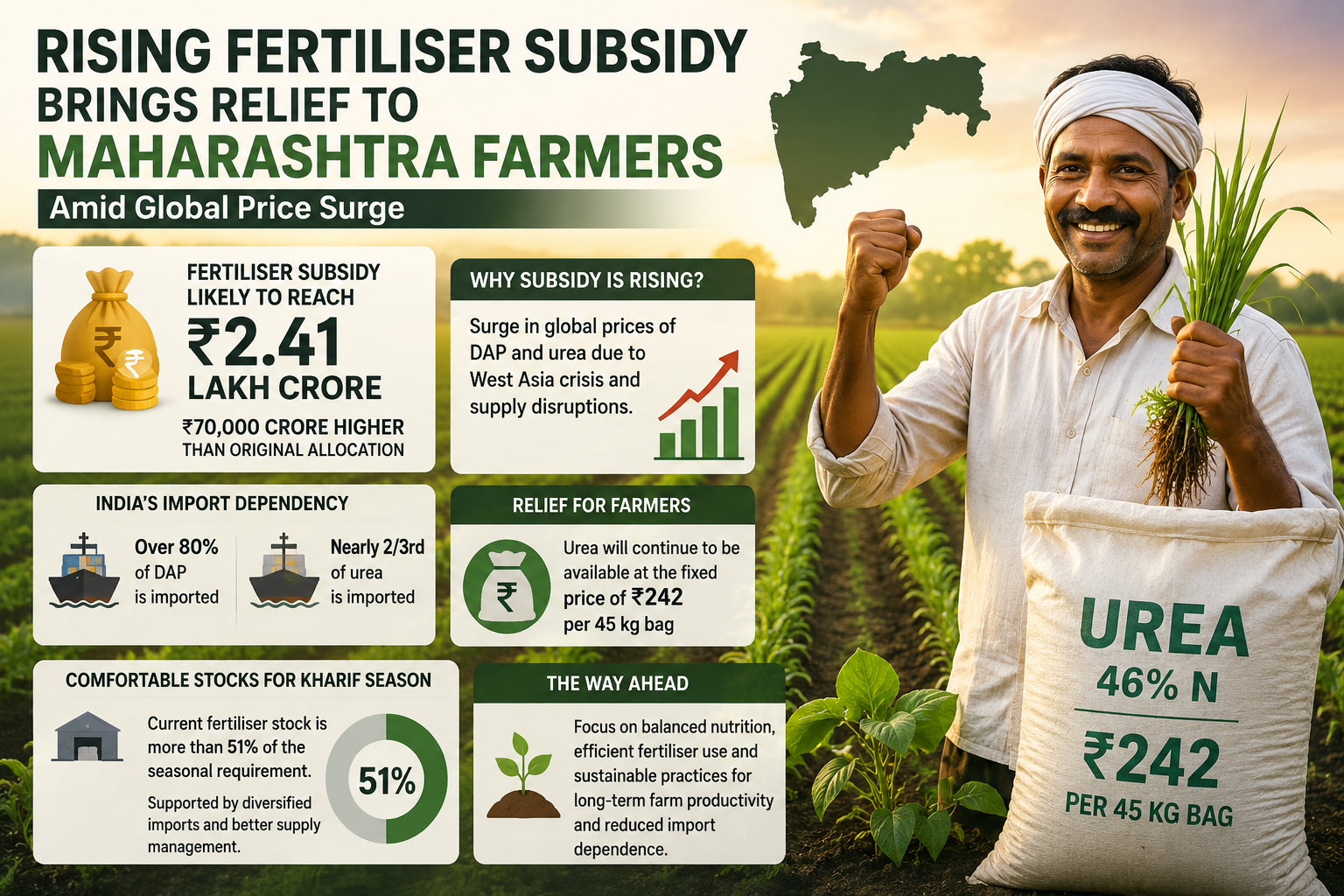
As global fertiliser prices continue to rise due to the ongoing West Asia crisis, the Government of India is expected to significantly increase its fertiliser subsidy support to protect farmers across the country, including Maharashtra. Recent reports suggest that the total fertiliser subsidy outlay may reach nearly ₹2.41 lakh crore, exceeding the original budget allocation by around ₹70,000 crore.
The increase comes at a crucial time for Maharashtra, where preparations for the upcoming Kharif season are already underway. Farmers across districts cultivating soybean, cotton, sugarcane, banana, onion, and paddy heavily depend on fertilisers such as urea and Di-Ammonium Phosphate (DAP) to maintain crop productivity and soil nutrition.
India imports over 80% of its DAP requirement and nearly two-thirds of its urea demand. Due to international supply disruptions and rising import costs, fertiliser prices in the global market have witnessed a sharp increase. However, to ensure that farmers are not burdened by these rising costs, the government has decided to continue providing fertilisers at subsidised rates.
Urea, one of the most widely used fertilisers in Maharashtra agriculture, will continue to be available at the fixed retail price of ₹242 per 45 kg bag. This move is expected to provide major relief to farmers facing increasing cultivation expenses and uncertain weather conditions.
The Ministry of Fertilisers has also assured that fertiliser availability for the Kharif season remains comfortable. Current stock levels are reported to be more than 51% of the seasonal requirement, supported by diversified import sourcing and proactive supply management.
For Maharashtra’s agriculture sector, stable fertiliser availability is crucial during the sowing season. Experts believe that while government support is helping farmers in the short term, a long-term focus on balanced nutrition, efficient fertiliser usage, and sustainable agricultural practices will be essential to reduce dependency on global market fluctuations and ensure sustainable farm productivity.